“We are now a power-limited industry”
Jensen Huang
Cooling is a major inefficiency in data centers. Ferveret’s Adaptive Phase Cooling solves this in an efficient and planet-friendly way.
Ferveret’s Adaptive Phase cooling vs air cooled
+55%
TFLOPs/W improvement
x2
Chip power
-96%
Reduction of cooling cost
-75%
Physical footprint
defining a new category of cooling
At Ferveret, we’re defining a new category of cooling - Adaptive Phase Cooling - inspired by the proven efficiency of nuclear reactor systems. Below is a simple visualization showing where our solution fits compared to other liquid cooling technologies.
What is Ferveret’s
Adaptive Phase Cooling?
At Ferveret, we understand both the strengths and the limitations of existing immersion cooling methods — single-phase and two-phase. Our Adaptive Phase Cooling combines the best of both while eliminating their drawbacks. Ferveret’s Adaptive-Phase Cooling may look similar to a single-phase immersion system from the outside, but inside, an entirely new process is at work. At the chip level, it might resemble conventional two-phase immersion cooling at first glance, yet the underlying mechanism is fundamentally different.
The result: a safer, more reliable, and significantly more efficient cooling solution, purpose-built for today’s high-performance computing demands.
How our technology differs from conventional two-phase immersion at the physical level:
Typical 2 Phase cooling
Typical two-phase cooling relies on a boiling process known as saturated boiling.
In saturated boiling, heat is removed through two mechanisms: the formation and growth of vapor bubbles, and the rewetting of the surface as those bubbles detach. This process creates relatively large bubbles that rise away from the surface of the chip and collect in a vapor plenum. As can be seen in the video.
Ferveret’s Adaptive-Phase Cooling
Ferveret’s Adaptive-Phase Cooling is inspired by a technique used in nuclear reactor systems known as subcooled boiling.
Unlike saturated boiling, Ferveret’s Adaptive Phase Cooling produces much smaller bubbles that detach more frequently and quickly recondense in the surrounding subcooled liquid. This rapid bubble turnover constantly refreshes the liquid at the surface of the chip as it can be seen in the video, greatly enhancing rewetting and heat transfer. The result is lower operating temperatures and the ability for chips to run reliably at higher power.
.png)
.png)
.svg)
Conventional systems rely on large tanks that house many servers and require bulky infrastructure, leading to integration challenges and limited flexibility.
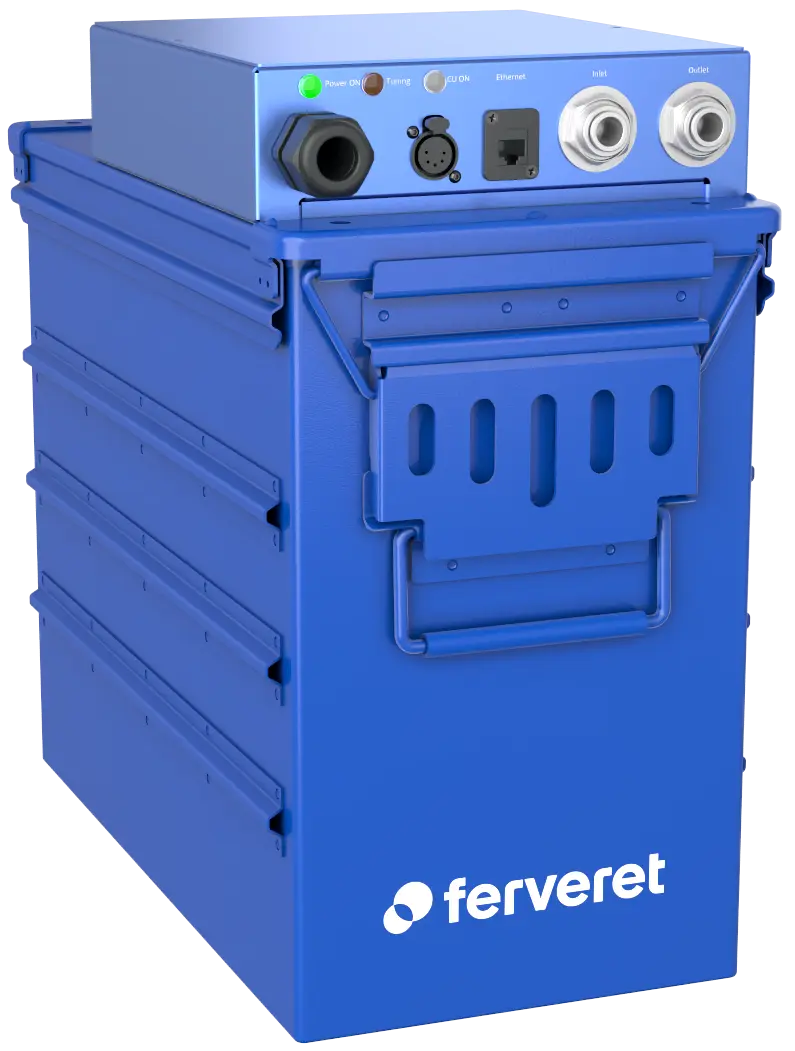
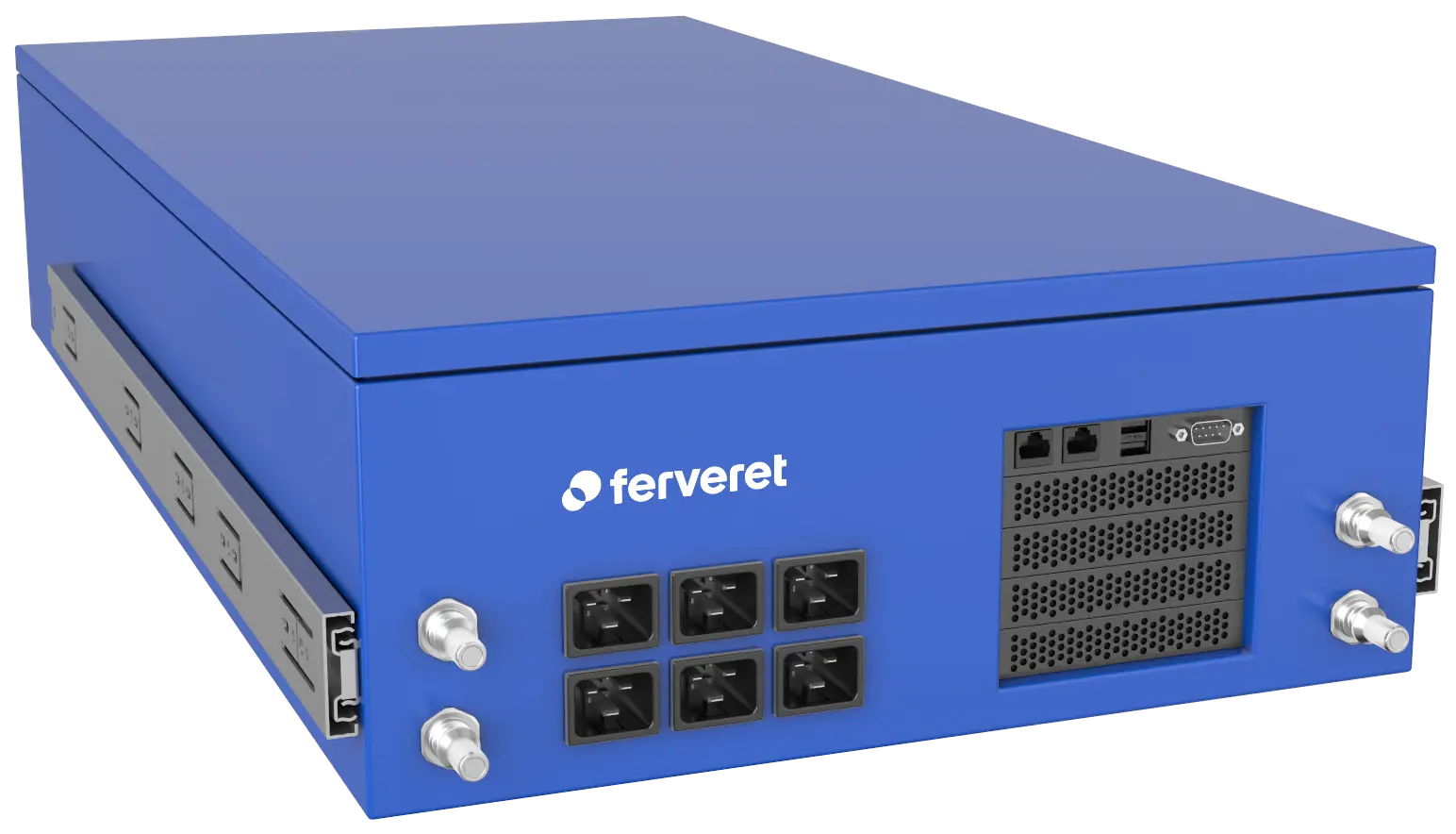
Enables compact, rack-ready tanks with one server each — a design that is easy to scale, space-efficient, and data-center friendly.

Requires powering down and physically lifting servers out of a shared fluid bath for maintenance — a process that can be disruptive and affect neighboring systems.
Enables true server-level serviceability without disturbing adjacent systems.
.svg)
Relying on saturated boiling, these systems often operate at higher pressures and require expensive pressure-tight designs. Large tanks consume significant volumes of dielectric fluid (with greater risk of fluid loss) further increasing capital and operational costs.
Relying on subcooled boiling, Ferveret systems operate near ambient pressure, making them easy to seal and highly cost-effective. They minimize dielectric fluid requirements and eliminate fluid loss, ensuring efficient and sustainable cooling.

These systems cannot be easily integrated into existing data centers or containerized edge environments. Their reliance on large tanks demands specialized infrastructure. Requires custom tanks and specialized facility build-outs (floor space, tank handling, custom plumbing).
Integration into existing data centers or containerized edge sites is seamless. Our solution is fully rack-ready, using the same racks as direct-to-chip cooled servers, making adoption in liquid-cooled facilities simple and straightforward. Uses a standard rack form factor, designed to slot directly into existing data center layouts. With minimal infrastructure changes.
.svg)
High global warming potential (GWP)
Regulated under PFAS guidelines
Low GWP
Not regulated under PFAS guidelines
.svg)
Until recently, the market wasn’t ready for immersion cooling — energy costs, density demands, and AI workloads hadn’t yet converged to make it essential. Traditional tank-based systems, while innovative, are too complex and slow to deploy and to gain traction.
Today, with data centers now power-limited and compute demand skyrocketing, the timing for Ferveret’s Adaptive Phase cooling has never been more urgent. Ferveret’s rack-based two-phase design makes immersion practical, fast to deploy, and scalable — exactly when the industry needs it most.
Would you like to know more about our technology?
Contact us