Data Centers
San Jose, CA – October 19th, 2026
Ferveret, an innovative developer of advanced liquid-cooling solutions for data centers inspired by nuclear reactor cooling systems, today announced that it has been named to Cleantech Group’s 2026 Cleantech 50 to Watch list. The annual recognition highlights 50 early-stage private companies worldwide advancing innovative technologies to address emerging energy, environmental and sustainability challenges.
“Being named to the Cleantech 50 to Watch reflects how central cooling has become to the energy challenge facing AI,” said Reza Azizian, CEO of Ferveret. “The rapid growth of AI and limited power availability are putting new pressure on datacenter infrastructure. As AI systems generate more heat, cooling increasingly determines how much of a facility’s electricity can turn into useful computing capacity. Ferveret’s Adaptive Phase Cooling technology uses a closed-loop, waterless approach to remove heat inside the server chassis. Our goal is to help data centers manage rising thermal demands and turn nearly all of their incoming power into compute rather than losing it to cooling overhead.”
Selected through nominations and voting by Cleantech Group’s expert panelists, this year’s honorees represent 12 countries, including 18 companies headquartered in the United States. Energy & Power was the largest category, with 17companies recognized for developing technologies that address growing electricity demand and grid infrastructure challenges. The 2026 list highlights technologies improving power access and grid flexibility as AI infrastructure expands. The full list of honorees and accompanying report are available at https://www.cleantech.com/50towatch/.
In its report, Cleantech Group highlighted Ferveret within its analysis of liquid cooling, one of the most active acquisition areas in clean tech: “One recipient of this year’s Cleantech 50 to Watch, Ferveret (U.S.), has developed adaptive-phase liquid cooling to more efficiently transfer heat off chips (andas a result, unlock more efficiency).” The report ties this to the industry’s push for more compute per unit of electricity, a metric it notes “finally received a consensus name: ‘tokens per watt.’”
Ferveret’s Adaptive Phase Cooling technology draws inspiration from nuclear reactor systems that use subcooled boiling. Unlike saturated boiling, subcooled boiling produces smaller bubbles that detach more frequently and recondense in the surrounding subcooled liquid. This continuously refreshes the liquid at the chip's surface, improving rewetting and heat transfer. Test results show lower operating temperatures and the ability to run chips reliably at higher power levels.
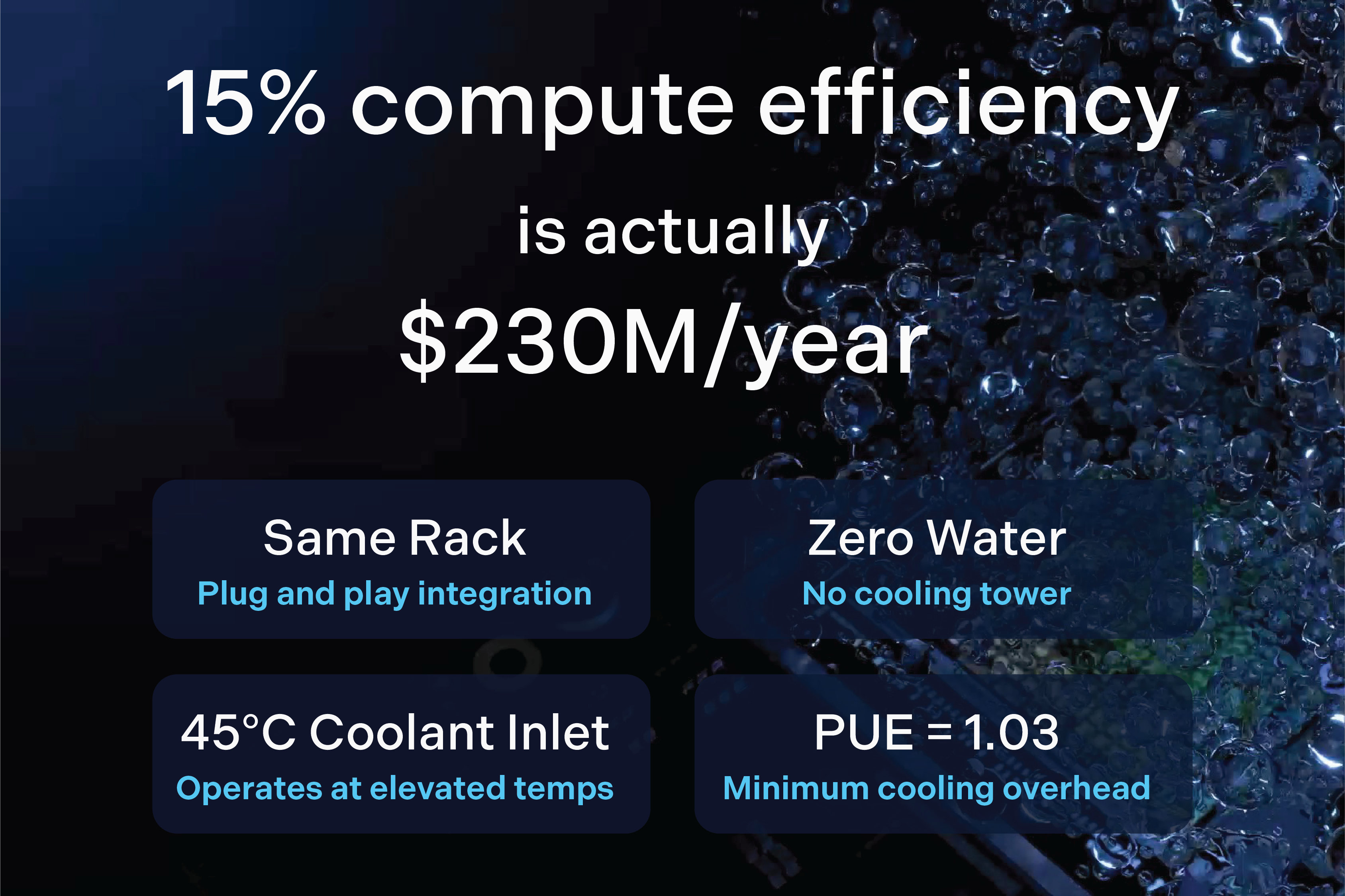
The recognition follows Ferveret’s benchmark studies with UCLA’s Computer ScienceDepartment and researchers at MIT showing significant advantages in compute output over traditional coolings. The results show that Adaptive Phase Coolingcan unlock up to 35% more usable compute from the same power envelope; validating the growing role infrastructure innovation will play as AI workloads continue to push the limits of modern computing.
Suscribe to our newsletter

See all